The block above is Hugging Face Space metadata; it is not application configuration.
mmv-voice — private, local-first transcription (Whisper + a local model)
Turn recordings into punctuated text on your own computer. Your audio, the transcript and the model all stay on your machine. No account, no API key, no upload, no telemetry. And the local model is only allowed to add punctuation: if it changes a single word or number, its output is thrown away and Whisper's own text is kept.
Local-first, concretely
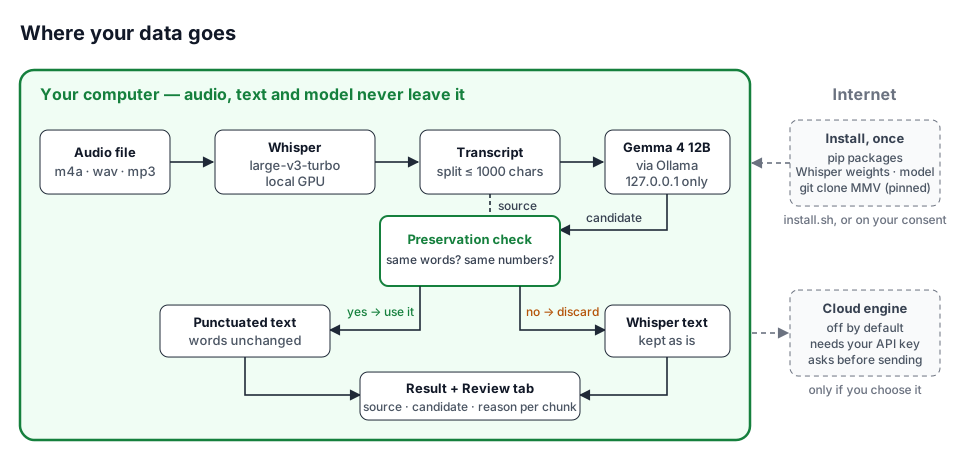
- Audio never leaves your computer. Whisper runs locally (GPU if available, otherwise CPU).
- The model is local, and the application enforces it. Formatting goes
to Ollama on a loopback address (
127.0.0.1,localhost,[::1]); the application refuses any other address before it ever calls the model. - The network is used once, at install time.
install.shdownloads the Python packages, the Whisper weights, the local model and the MMV harness, asking before each download. After that, with the default settings, the tool makes no network calls while you work. If the Whisper weights are missing, the app asks before downloading them (model file only, never your audio). Opt-in extras differ:pyannote.audiospeaker attribution fetches its model from Hugging Face on first use, and the cloud engine sends text after you confirm. (Third-party programs such as Ollama follow their own settings.) - Nothing to sign up for. The default engine needs no account, key or licence server.
- Cloud is opt-in, twice. An optional cloud engine exists for people who want it; it is off by default, needs your own API key, and shows a confirmation dialog before any text is sent.
- Your words are protected. See How your words are protected.
Quick start
git clone https://github.com/mobius-style/mmv-voice && cd mmv-voice
bash install.sh --check   # shows what is missing; changes nothing
bash install.sh           # installs locally, asks before every download
bash launch.sh            # opens the app
Recording a meeting? Read Long recordings
first. Needs Linux with a desktop, Python 3.10+, ffmpeg, python3-tk, and
Ollama running. An NVIDIA GPU with 8–16 GB is
recommended; a single 16 GB card is enough. install.sh never uses sudo and
never starts or stops Ollama; it tells you the exact command when something
system-level is missing. Details and manual steps: Setup.
Using it
- Open an audio file (m4a, wav, mp3 …). Transcription starts at once and streams into the left pane; the language is detected automatically.
- Formatting follows automatically. The transcript is split into chunks of up to 1,000 characters and each chunk goes to the local model for punctuation and paragraph breaks.
- Read the result in the right pane. Chunks whose candidate failed the word-and-number check are shown unformatted, exactly as Whisper wrote them.
- Check the "Review" tab if you want to see, per chunk, the source, the model's candidate and why it was accepted or rejected.
- Save the text, or (optional) export minutes or a digest file. "Stop after current segment" keeps the segments already shown, releases Whisper, then formats them. It does not interrupt a model call instantly, and text of the current 30-second window that was decoded but not yet displayed is discarded.
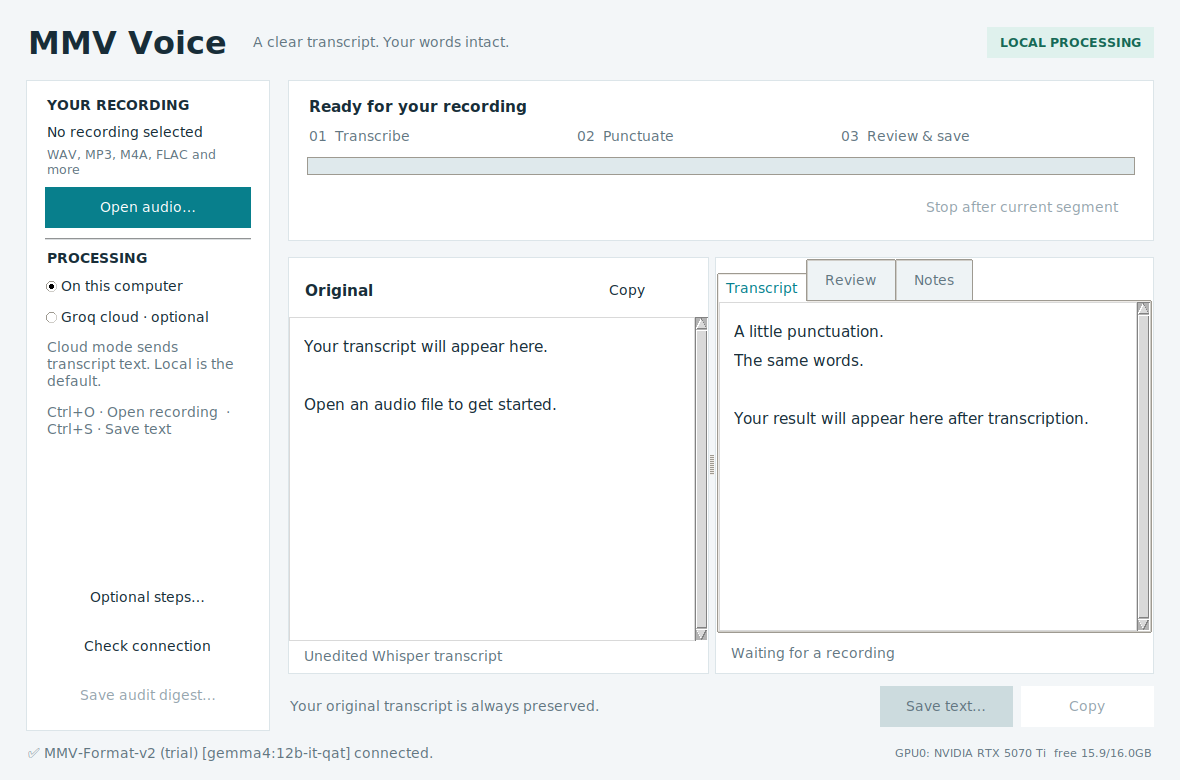
Use Ctrl+O to open a recording and Ctrl+S to save the selected result tab as UTF-8 text. The original and result panes are read-only; copy or export for editing. Optional steps holds the extra processing settings. Progress shows the active stage and elapsed time; opening another file is disabled until processing finishes.
Optional features — speaker attribution, an extra LLM fidelity pass,
minutes — are off by default and use the same local model. (If you
additionally install pyannote.audio for audio-based speaker attribution,
it downloads its models from Hugging Face the first time it runs.)
How your words are protected
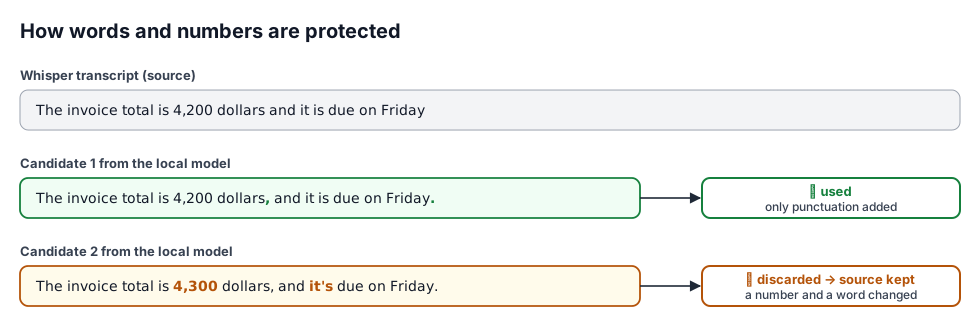
The check compares the words and numbers of every candidate with Whisper's text (case-sensitive). Only punctuation and whitespace may differ. This is enforced by code and covered by tests; it is not a formal proof, and it cannot fix words that Whisper itself misheard. One consequence: if the model changes capitalisation (for example on an all-lowercase English input), the chunk falls back to Whisper's text unformatted.
Readable draft mode (opt-in, review required)
Since v0.2.8 the "Optional steps" dialog has a checkbox Readable draft instead of punctuation only. It is off by default and changes the contract for that job:
- The local model may rewrite for readability: punctuation, paragraphs, grammar, meaningless fillers and repeats, explicit self-corrections.
- The word-and-number guarantee above does not apply. Instead the prompt
puts "no unsupported guesses" before fluency: names, places, terms and
unclear words must be kept as heard and followed by the marker
(※要確認)("please verify", deliberately identical in English, Japanese and Chinese). Three deterministic rules (changed numerals, changed negation words, changed uncertainty words) append the same marker at the end of the chunk when they fire; they are warnings, not proof either way. - The original text, the raw model candidate, a diff and the rule flags stay
in the Review tab; the digest records
format_mode: readableandhuman_verified: false. Every readable result needs human review — the status line says so. - Chunks are split at sentence ends where possible (source reconstructed
exactly); the model is
gemma4:12b-it-qatby default, or the digest-pinnedgemma4:26b-a4b-it-qatwithMMV_READABLE_MODEL. MMV's question routing, post-validator and re-anchor scaffold are off for this path; the endpoint stays loopback-only.
Measured on 38 known inputs (24 FLEURS transcripts, 2 meeting excerpts, 12
synthetic; English, Japanese, Chinese) × 3 repeats × 12B/26B: the five known
unsupported substitutions of the previous readable build (a guessed city
name, a changed person name, an invented physics term, cooches → couches)
went from 9/15 to 0/15 on both models; 41/114 (12B) and 51/114 (26B) outputs
carried at least one marker (the shipped build narrows the rule lexicon and
raises the context window to 8192 after review, so rule-added chunk markers
are rarer than in that measurement). Remaining failures: an unclear Chinese phrase
deleted by 26B, a statement turned into a question by 12B, a wrong English
person name and a Japanese 海外/海岸 confusion left unmarked, some
over-marking of clear terms. This is a known-data, single-reviewer,
exploratory regression — not an error rate. Automatic (unreviewed) adoption
is on hold; the mode is offered for review-assisted use. Full report:
eval/mmv_readable_v2_20260926.md; mode
contract: docs/READABLE_MODE.md.
Held-out comparison of the shipped engines (v0.2.8 code, 36 new FLEURS
clips in English/Japanese/Mandarin + one 17-minute AMI meeting, 3 repeats,
report). On read speech the
readable draft is nearly verbatim: 0 invented tokens, ≤0.3 omitted tokens
per 100, and the error rate against the reference is unchanged (English 12B
−0.3 pt, 95% CI [−0.9, 0.0]; Japanese +0.1/+0.2 pt; Mandarin 0.0) — it does
not repair recognition errors. Its (※要確認) markers land on real
recognition errors most of the time (Japanese 18/21 and 24/33, Mandarin
12/14 and 15/21 for 12B/26B) but leave roughly half of the error regions
unmarked, and it placed no markers on English. On the meeting, where the
default engine retained all 18 chunks unformatted, the readable engines
formatted every chunk but removed 3.5 (12B) to 9.3 (26B) content tokens per
100 — mostly function words and false starts — and 26B invented a numeral
once (the numeric rule flagged that chunk). Punctuation position F1 was
equal or slightly higher than the default. These numbers do not change the
contract: readable output is a draft for human review. v0.2.10 adds a
code-level bound on top of it: a draft that changes numerals, drops more
than a few content words, or adds content absent from the source is
discarded and the source chunk kept (with the draft shown in the Review
tab); a changed count of negation words counts as content. Applied to the
held-out outputs above, that keeps the source for 14/18 (12B) and
15/18 (26B) meeting chunks — content loss 9.3 → 0.3 per 100 (26B),
invented tokens 0 — and touches read speech almost never (3/36 English
chunks, 12B). Details: held-out report,
mode contract.
Validated on a second, native-English meeting (AMI ES2008a) and 36 more new clips with the shipped v0.2.11 code (report): on the meeting the guard met every declared expectation (after-guard content loss 0.2 and 0.1 per 100, invented 0, error rate within 0.1 pt of Whisper) while returning 18/42 (12B) and 30/42 (26B) chunks to the source. On read speech it retained more than the declared bound for 26B (3–9 of 36 per language) — mostly paraphrases and one Japanese false-positive class fixed in v0.2.12 (9 → 6); the thresholds were left unchanged. The English prompt gained three worked marking examples (E3) after a frozen comparison: markers on real errors 0 → 3 on the clips, none on the meeting for any English prompt — English marking remains weak.
v0.2.13 (12B only, report): the Japanese and Mandarin readable prompts for the 12B model now ask for local edits that keep content words and their order; each was adopted by a per-language frozen rule on 72 new FLEURS clips (Japanese CER 5.12 → 4.77%, punctuation F1 0.63 → 0.68; Mandarin CER unchanged, punctuation F1 0.90 → 0.95; a proposed English prompt lowered punctuation F1 and was rejected, so English keeps E3). The guard also gained three rules for all languages: numerals must keep their order, a changed uncertainty or conditional expression retains the source instead of only marking it, and surviving content tokens must keep their relative order (so two people cannot swap roles with the same words); English personal pronouns count as content after review found he → she passing unnoticed. Applied to every earlier held-out output, the new rules retain no additional chunk. The 26B prompt is unchanged and was not re-evaluated with the new rules.
A sibling of mobius-style/mmv: every
LLM call goes through the MMV harness, never a raw API. v0.2 replaced the
v0.1 rewrite-style formatter with this minimal-edit one; v0.1 remains
available as tag v0.1. This is a local trial build: no fine-tuning, small
read-speech test panels, no claim of general model quality — measured
results and their limits follow below and in
MMV_FORMAT_STATUS.md.
English results (the language this release is built around)
Everything — documentation, UI, prompts, tests — is written for English first. v0.2.4 fixes the one English weakness found in v0.2: the prompt's semicolon hint made the model add semicolons that do not belong (on the 2026-09-24 panel every changed clip gained one, and punctuation type-accuracy fell from 0.681 to 0.500). v0.2.4 deletes that single sentence, nothing else.
Measured on 12 new English FLEURS clips (never used before), Whisper large-v3-turbo, 3 temperature-0 runs per clip, punctuation scored against the reference transcript:
| Output | Punctuation position F1 | Position + type F1 | Clips accepted |
|---|---|---|---|
| Whisper alone | 0.846 | 0.821 | — |
| v0.2 formatter | 0.892 | 0.659 | 11/12 |
| v0.2.4 formatter | 0.878 | 0.854 | 11/12 |
- Words are never changed. Every delivered chunk has exactly Whisper's words and numbers; where a candidate changed anything (1 of 12 clips here), Whisper's text is kept. On the earlier 8-clip panel, 8/8 clips were kept word-for-word with 0 fallbacks.
- Punctuation now roughly matches Whisper's own on this panel (0.854 vs 0.821 type-aware; the intervals overlap, so no difference is established), instead of clearly worse (v0.2: 0.659, an interval that does not overlap v0.2.4's). In practice v0.2.4 leaves Whisper's English punctuation alone on most clips (7 of 12 unchanged) and adds punctuation on 4.
- Why the guarantee matters. The rewrite-style formatter used up to v0.1 can silently change words — on the 2026-09-24 clips it reworded a list and once returned a request for the transcript instead of formatted text.
Scope: small read-speech panels; 95% clip-bootstrap intervals overlap (details in eval/mmv_voice_v024_20260926.md); FLEURS is public, so overlap with the models' training data is unresolved. Earlier record: eval/mmv_format_12b_qat_20260924.md (overall verdict HOLD, for Japanese).
Long recordings (meetings): what to expect today
Tested on a real 17.5-minute, four-person meeting (AMI corpus ES2004a, CC BY 4.0), on one RTX 5070 Ti:
- Transcription works and is fast: 32 s for the whole meeting including model load (27 s transcribing), whole-card VRAM peak about 5.7 GiB; word error rate 27% against the manual transcript (overlapping, informal speech).
- Formatting mostly steps aside: only 1 of 12 chunks was formatted; the other 11 were returned exactly as Whisper wrote them. Your words are safe, but on meetings you mostly get Whisper's own punctuation.
- Observed causes: in 6 chunks the MMV governance layer prepended a
boilerplate sentence to conversational text; in the other 5 the model
changed capitalisation — in 4 at a chunk that starts mid-sentence (the
1,000-character split cuts sentences), plus mid-chunk changes such as
"And" → "and"; one also dropped a repeated "Thank you". All are rejected
by the word check, as designed. Two fixes were measured and are on
hold: v0.3 (strip the known boilerplate before the check, split at
sentence ends) raised the formatted share on a new held-out meeting from
0/6 to 2/6 but missed its ≥50% gate on another; v0.3b added Whisper
condition_on_previous_text=False, which removed the repetition loops on all three meetings and reached 4/5 formatted chunks, but on the new held-out meeting Whisper's automatic language detection then chose Dutch for an English meeting and WER rose from 43% to 85% (the two development meetings: +0.04 and −3.47 points). Reports: v0.3, v0.3b.
Reference: Mandarin Chinese
Exploratory, 8 FLEURS cmn_hans_cn clips, measured on v0.2.2 (voice_mmv.py
unchanged through v0.2.3; Chinese uses
the English prompt branch; v0.2.4's one-sentence English prompt change has
not been re-measured on Chinese). 7/8 clips accepted in all 3 identical
repeats (21/24 runs); the one rejected clip had a name separator changed and
fell back to Whisper's text. Whisper's Mandarin output is lightly punctuated,
and formatting raised punctuation-position F1 from 0.278 to 0.786 and
position+type F1 from 0.056 to 0.500; CER stayed 14.45% by construction.
Record: eval/mmv_voice_zh_20260926.md.
What it does
- Transcription — Whisper
large-v3-turbo(GPU when available, language auto-detected). The raw log streams into the left pane. - Formatting (default engine: MMV-Format, local) — punctuation and paragraph breaks only. Each chunk's candidate must pass a lexical/numeric preservation check; otherwise the unformatted source is retained and the "Review" tab shows source, candidate and rejection reason.
- Speaker attribution (optional, off by default) — pyannote.audio if
installed and gated models are approved; otherwise text-based
attribution through MMV. Output is structured as
Speaker 1: …turns (話者1:for Japanese). Unattributable utterances stay visiblySpeaker unknown. - Fidelity check (optional, off by default) — an additional LLM pass comparing each source/formatted pair; suspicious chunks get a ⚠️ marker.
- Minutes (optional, off by default) — Markdown minutes (summary / key points / decisions / action items) from the formatted text, first 24,000 characters.
- Secretary digest — one button writes
voice_note_<ts>.mdinto the MOBIUS secretary digest directory with metadata, source/candidate/reason audit andhuman_verified: false.
Engines
| Engine | Model | Runs on | Purpose |
|---|---|---|---|
| MMV-Format (default) | gemma4:12b-it-qat (Ollama) |
local | punctuation-only formatting with preservation check |
| MMV-L (opt-in) | gpt-oss-120b via Groq |
cloud | legacy path; sends transcript text off-machine after an explicit confirmation dialog |
- MMV-Format uses the profile shipped in this repository
(
profiles/mmv_format_12b_qat.json): MMVroute_transformer,post_validatorandforce_reanchor_v2stay on, temperature 0,num_ctx8192,max_tokens1024,think: false. The canonical MMV release profiles are not modified. - Before the first call, the tool checks that the Ollama model tag and
digest match the evaluated build
(
38044be4f923e5a55264ed7df4eaac2676651a905f735197c504045140c02bd3). On mismatch it does not generate and keeps the source text; it never silently falls back to another model. - Normally one generation request per chunk, no quality-driven regeneration. The harness's own retry on transport/empty-response errors (max 1) remains.
- Input is split at about 1,000 characters without cutting an ASCII word or a numeric expression; the split is checked to reconstruct the original string exactly. An oversized single token is retained unformatted rather than cut.
- MMV-L reads its binding from the MMV release pointer
(
operate-fr-bench/releases/large/current.yaml) and needsGROQ_API_KEY(environment orMOBIUS_MMV/.env). Without it the cloud radio button is disabled. The digest records which engine was used.
This is not a transcription-error corrector. A candidate that fixes a misheard word is still rejected because the words changed. Punctuation can change meaning, and the preservation check does not prove semantic fidelity. Typo correction, summarisation and speaker attribution are separate problems. Languages other than Japanese and English are unevaluated.
Measured results (summary)
From MMV_FORMAT_STATUS.md and eval/mmv_format_12b_qat_20260924.md, FLEURS read speech, Whisper large-v3-turbo, 3 repeats per clip at temperature 0:
| Panel | Candidate acceptance | Actually formatted | Source retained | Punctuation-position F1 vs reference |
|---|---|---|---|---|
| English, 12 new clips × 3 (2026-09-26), v0.2.4 prompt | 11/12 clips | 4/12 clips (12/36 runs); 7/12 unchanged | 1/12 clips | 0.846 → 0.878 (type-aware 0.821 → 0.854) |
| English, 8 held-out clips × 3 (2026-09-24), v0.2 prompt | 8/8 clips | 7/8 (each added a semicolon the reference lacks) | 0/8 | 0.766 → 0.769 (type-aware 0.681 → 0.500) |
| English meeting, 17.5 min, 12 chunks (AMI ES2004a), v0.2.4 | 1/12 chunks | 1/12 | 11/12 | — (WER 27.2%, unchanged by design) |
| Mandarin, 8 clips × 3 (2026-09-26, reference; repeats identical) | 7/8 clips (21/24 runs) | 21/24 | 3/24 | 0.278 → 0.786 (type-aware 0.056 → 0.500) |
| Japanese, 12 new clips, v2 prompt | 91.7% (33/36) | 30/36 | 3/36 | 0.857 |
| Japanese, same clips, previous v1 prompt | 83.3% (30/36) | 24/36 | 6/36 | 0.857 |
| English, same 8 clips (regression, pre-release build, 1 run) | 8/8 | 6/8 | 0/8 | — |
Acceptance means the candidate passed the preservation check, not that its punctuation is correct. The post-hoc punctuation-position F1 is identical for v1 and v2 (paired delta +0.001, bootstrap 95% CI [−0.089, +0.088]); v2 misses fewer sentence ends but inserts more commas than the reference. The panels are small; none of this is a population guarantee. The 2026-09-24 trial that was put on HOLD is kept unchanged in eval/mmv_format_12b_qat_20260924.md.
Repository layout
mmv-voice/
├── whisper_gui.py                 # GUI and pipeline
├── voice_mmv.py                   # MMV-Format engine: prompts, preservation check, splitting, audit
├── voice_readable.py              # opt-in readable draft engine: sentence chunks, markers, diagnostics
├── desktop_ui.py                  # Tk workspace layout
├── profiles/mmv_format_12b_qat.json
├── profiles/mmv_readable_*.json, profiles/readable_prompts.json
├── tests/                         # formatter, readable-mode and desktop lifecycle tests
├── eval/                          # measured trials and raw metrics (JSON)
├── MMV_FORMAT_STATUS.md           # current adoption status and measurements
├── launch.sh / whisper_tool.desktop
├── requirements.txt
├── LICENSE                        # AGPL-3.0
└── README.md
Private audio, transcripts and local backups are ignored by .gitignore.
Never commit audio files.
Requirements and tested environment
| Item | Tested with |
|---|---|
| OS | Linux (Tk desktop) |
| GPU | 2 × NVIDIA RTX 5070 Ti (16 GB); Ollama on GPU 0, Whisper on GPU 1 |
| Python | 3.10.14 (pyenv) |
| PyTorch | 2.10.0 + cu128 (Blackwell needs cu128 or newer) |
| Whisper | openai-whisper 20250625 |
| LLM | Ollama + gemma4:12b-it-qat (7.2 GB, Q4_0 QAT) |
| MMV harness | mobius-style/mmv, operate-fr-bench/harness/adapters.py |
A single 16 GB GPU also works: Whisper is loaded only after the free VRAM
threshold (MIN_FREE_VRAM_GB, default 7 GB) is met, falls back to CPU
after a 30 s wait, and is released before formatting starts. The launcher
does not start or stop Ollama; an inference server belongs to whoever
started it.
Setup
Recommended: bash install.sh (see Quick start). It performs
the steps below, skips what is already present, and writes MMV_REPO to a
local .mmv-voice.env that launch.sh reads. Manual equivalent:
# 1. system packages
sudo apt install ffmpeg python3-tk
# 2. PyTorch matching your CUDA (Blackwell example)
pip install torch torchvision torchaudio --index-url https://download.pytorch.org/whl/cu128
# 3. Python packages (openai-whisper, requests, pyyaml)
pip install -r requirements.txt
# 4. Ollama and the evaluated model (network and disk required, once)
ollama serve            # in another terminal, if not already running as a service
ollama pull gemma4:12b-it-qat
# 5. the MMV harness
git clone https://github.com/mobius-style/mmv ~/MOBIUS_MMV
export MMV_REPO=~/MOBIUS_MMV
Optional: pip install pyannote.audio and accept the Hugging Face gates
for pyannote/speaker-diarization-3.1 and pyannote/segmentation-3.0 for
audio-based speaker attribution.
Run
bash launch.sh
or install whisper_tool.desktop (edit its Exec= path) and use the
desktop icon. Pick an audio file; transcription starts immediately and
formatting follows. "Stop after current segment" keeps the segments shown so
far and formats them after Whisper releases its resources (the remainder of the
current 30-second window is discarded).
Configuration
Environment variables:
| Variable | Default | Meaning |
|---|---|---|
MMV_REPO |
~/デスクトップ/mobius_ai/MOBIUS_MMV |
path of the MMV repository (harness + release pointers + digest dir) |
MMV_FORMAT_HOST |
http://127.0.0.1:11434 |
Ollama endpoint for MMV-Format; loopback HTTP only, anything else is refused |
WISPER_PYTHON |
pyenv 3.10.14, then auto-detect | interpreter used by launch.sh |
GROQ_API_KEY |
— | only for the opt-in MMV-L cloud engine |
MMV_FORMAT_MODE |
verbatim |
readable pre-selects the readable-draft checkbox; any other value is refused |
MMV_READABLE_MODEL |
gemma4:12b-it-qat |
readable mode only; gemma4:26b-a4b-it-qat (digest-pinned) is the other supported tag |
Constants at the top of whisper_gui.py:
| Constant | Default | Meaning |
|---|---|---|
WHISPER_MODEL_SIZE |
large-v3-turbo |
large-v3 is more accurate, ~4.7× slower, needs ~11 GB |
WHISPER_LANGUAGE |
None (auto) |
e.g. "ja" to pin the language |
MIN_FREE_VRAM_GB |
7.0 |
raise to 11.0 for large-v3 |
FORMAT_CHUNK_CHARS |
1000 |
maximum characters per formatting request |
If the MMV harness or the formatting profile cannot be loaded, formatting is disabled with a visible error; there is no silent fallback to a raw model call.
Review tab, minutes and digest
- Review tab — for every chunk: status (formatted /
unchanged / source retained), reason, source text and model candidate.
With the optional fidelity check on, the LLM verdicts are appended and
flagged chunks are marked
⚠️in the formatted text. - Notes tab — Markdown; sections without content read "(none)"; the instruction forbids adding anything not in the transcript.
- Secretary digest — written to
$MMV_REPO/addons/secretary/state/digests/voice_note_<ts>.mdwith source audio, language, engine, profile path, speaker backend, fidelity summary andhuman_verified: false.
Tests
CUDA_VISIBLE_DEVICES="" xvfb-run -a python3 -m unittest discover -s tests -v
Desktop tests require Tk and Xvfb (or an existing display). They cover the main-thread event queue, cooperative stop, save/export and minimum window layout without loading a GPU model.
Covers the real harness path through a local HTTP fixture, rejection of
word/number changes, model-digest mismatch, exception handling that keeps
the exact source, splitting without cutting tokens, refusal of non-loopback
endpoints, and digest provenance. Passing tests are not a claim about
formatting quality; that comes only from held-out audio trials recorded in
eval/.
Troubleshooting
| Message | Cause | Fix |
|---|---|---|
MMV not connected |
Ollama not running | start ollama serve (or the system service) |
gemma4:12b-it-qat with measured digest … is required |
model missing or a different build | ollama pull gemma4:12b-it-qat; a different digest is outside the evaluated configuration |
MMV configuration error |
MMV_REPO wrong or harness moved |
set MMV_REPO |
MMV_FORMAT_HOST must be a loopback HTTP origin |
remote endpoint configured | use http://127.0.0.1:<port> |
No module named 'whisper' |
packages not installed | pip install -r requirements.txt |
ffmpeg not found |
ffmpeg missing | sudo apt install ffmpeg |
CUDA out of memory |
not enough VRAM | close other GPU applications, or let the tool fall back to CPU |
Versions
| Tag | Date | Content |
|---|---|---|
v0.1 |
2026-07-06 | original release: MMV-M (gemma4:12b) via release pointer, filler removal and rewriting, fidelity check, speaker attribution, minutes, digest, opt-in MMV-L |
v0.2.13 |
2026-09-27 | readable draft, 12B: Japanese and Mandarin prompts narrowed to local edits (selected per language on 72 new clips; English unchanged); guard adds ordered numerals, uncertainty/condition retention and content-order rule; GPU status tolerates a failed CUDA device |
v0.2.12 |
2026-09-26 | guard validated on a second meeting (report in eval/); Japanese added-content rule no longer flags a source name wrapped in new particles; English readable prompt E3 (worked marking examples) adopted by frozen rule |
v0.2.11 |
2026-09-26 | English-only comments and code-spanned examples (gate compliance; no behaviour change) |
v0.2.10 |
2026-09-26 | readable draft: bounded-edit guard (numerals and negation count unchanged, content loss ≤ min(15, max(1, 3/100)), no added content incl. Japanese kana words) keeps the source chunk on violation; readable checkbox disabled while the cloud engine is selected |
v0.2.9 |
2026-09-26 | documentation: held-out comparison of the shipped engines (default vs readable 12B/26B) added to eval/ |
v0.2.8 |
2026-09-26 | opt-in readable draft mode (voice_readable.py: rewrite for readability, (※要確認) markers for unclear spans, sentence-end chunking, 12B or digest-pinned 26B); default engine and its guarantee unchanged |
v0.2.7 |
2026-09-26 | landing page: dark mode restored (follows the OS prefers-color-scheme; light unchanged) |
v0.2.6 |
2026-09-26 | sidebar layout fix for HiDPI displays (cloud-engine choice was clipped at 1.33× scaling); v0.3 / v0.3b HOLD reports added to eval/; stale "being measured" wording and diagram label updated |
v0.2.5 |
2026-09-26 | desktop UI refresh: one workspace (source and result side by side), main-thread event queue, sequential stop → release → format lifecycle, UTF-8 text export (Ctrl+O / Ctrl+S), elapsed time and explicit local/cloud state; responsive landing page. No change to prompts, profiles, validator or chunking |
v0.2.4 |
2026-09-26 | English prompt: semicolon hint removed (measured on 12 new clips); install.sh one-command local installer (also pre-fetches Whisper weights so work is offline); local-first README and diagrams; long-meeting result documented |
v0.2.3 |
2026-09-26 | documentation only: English results as the lead topic of the README and landing page; Mandarin reference measurement added in eval/ |
v0.2.2 |
2026-09-25 | documentation only: local-first wording, Hugging Face metadata (v0.2.1 had invalid Space metadata) |
v0.2 |
2026-09-25 | default engine replaced by MMV-Format (punctuation-only, preservation check, digest pinning, audit in report); speaker / fidelity / minutes now off by default; English documentation; measured trials in eval/ |
The v0.1 formatter rewrote text (filler removal, spoken-to-written style)
and relied on an LLM fidelity check to catch silent changes. v0.2 inverts
that: the model may only add punctuation, and a deterministic check
enforces it. If you need the old behaviour, check out tag v0.1.
Local-first and privacy
- No network at run time by default. Whisper weights and the Ollama
model are loaded from local disk; if the Whisper weights are missing, the
app asks before downloading them (model file only). The formatter endpoint
is restricted to loopback (
127.0.0.1/localhost/[::1]) and the application refuses any other host. - Nothing leaves the machine unless you choose it. Text is sent off-machine only when the MMV-L cloud engine is selected, and only after a confirmation dialog names the destination; the digest records which engine was used.
- Your data is not part of this repository. Audio, transcripts, digests and reference CSVs are git-ignored.
- No telemetry, no accounts, no API keys for the default path.
License
AGPL-3.0 — Copyright (C) 2025-2026 MOBIUS LLC (author: Taiko Toeda). Sibling of mobius-style/mmv. The MMV harness, frozen profiles and release pointers are artefacts of the mmv repository; this repository contains only the application layer that calls them.